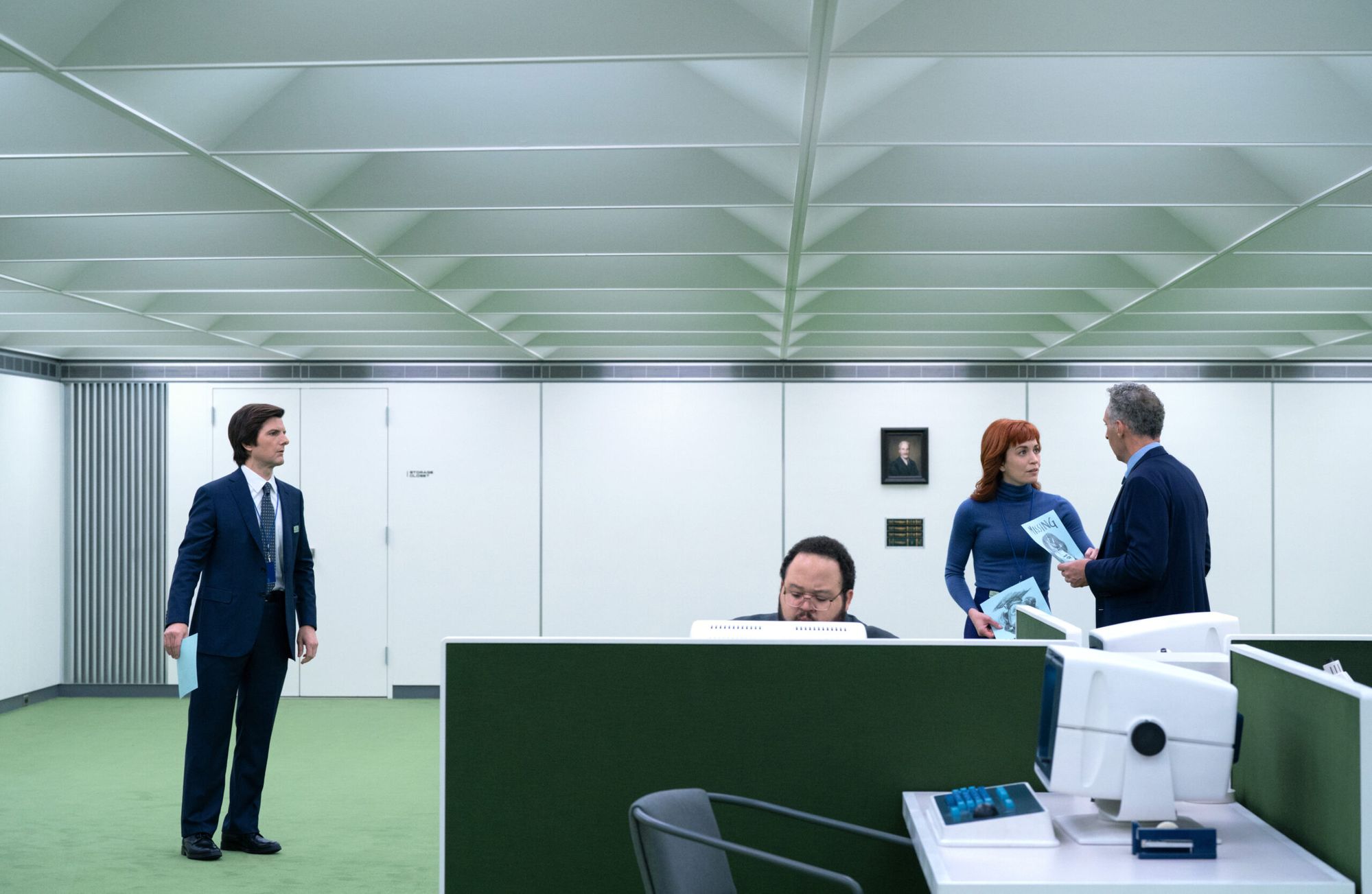
Near the end of the first episode of Severance, about a minute into the credits, there is a card for the people who decorated the set. It is a calm, simple card. Role titles on the left in small type, names on the right in larger type, everything aligned to a center line so precisely that you could rule a pencil down it. The show is about a company so obsessed with order that its employees spend their days sorting numbers into bins, and its credits look like they were built by the same company. But there's an error on it. Do you see it?
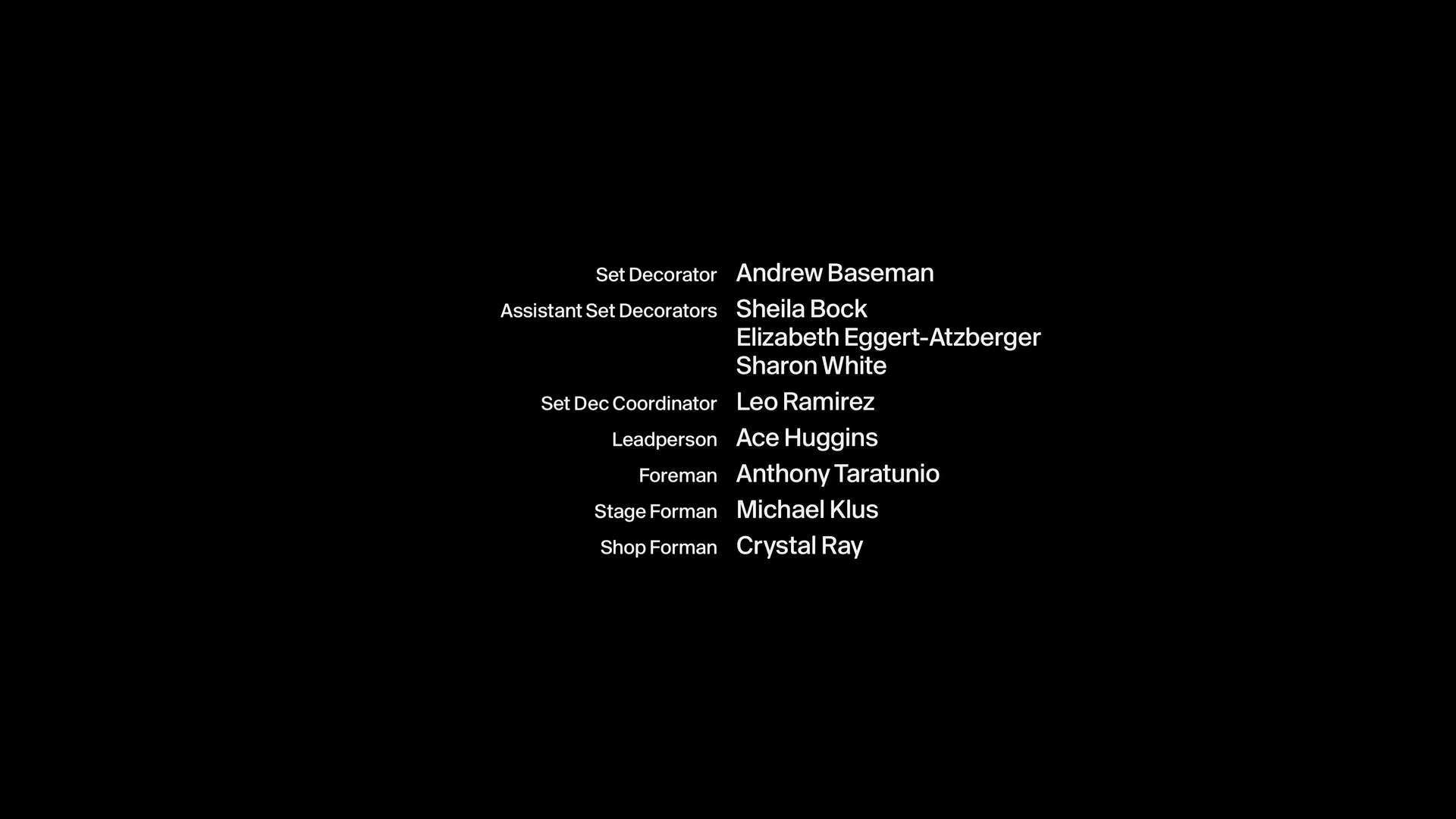
Seven lines down, the card says Foreman.
The line under it says Stage Forman.
The line under that says Shop Forman.
There is no e. Not on one line, which could be a slip, but on two. And it is not a matter of style, or of a regional spelling, or of an old trade usage we were too young to know. The word that is spelled correctly is sitting one line above the two that are not, on the same card, in the same typeface, set by the same hand.1
Then we looked at the second episode. Same card, same three lines: Foreman, Stage Forman, Shop Forman. Every episode of the season. Nine episodes of one of the most carefully designed shows on television, and the same two missing letters in every one.1
01Are we sure?
When we first showed this to people, the first question was always the same: are you sure that's a typo? It's a fair question, and we owe it a careful answer, because our credit text comes from a machine reading the picture, and machines misread.
We pulled the frames and looked at them with our own eyes. The machine was right.1
Next: could Forman be a real job? It isn't. The trade word is foreman, and nearly every production we have looked at that credits a foreman spells it with the e. Severance is one of five that don't.1
And here's the clincher. The same roll, on a later card, credits a Scenic Foreman and a Foreman Carpenter, both spelled correctly. The people who made this roll knew how to spell the word. They spelled it right at least three times. They also spelled it wrong, in the same places, every week.1
That's the puzzle. A typo is supposed to be an accident, and accidents are supposed to be random. This one is not random. It is one of the most consistent things on the card.
02It isn't only Severance
Once you start looking, they turn up elsewhere.
In the second season of Big Little Lies, on the card for the additional photography unit, two people are credited as General Foremen. The line directly beneath them reads Location Forman.2
On the costume card of Knives Out, between the tailor and the wardrobe production assistants, there is a credit for an Ager / Dryer.3 The job is real. An ager/dyer is the person who makes new clothes look old (sanding, staining, bleaching, dirtying them until they match a character's life) and who dyes fabric to colors a designer can't buy.4,5 The second word is dyer, as in dye. Severance has the same credit, spelled the same wrong way.1 Of the productions we have measured that credit the job, roughly one in thirty calls it dryer.
These are not obscure productions. They are Rian Johnson's Knives Out, HBO's Big Little Lies and Apple's Severance, a murder mystery, a prestige drama and a flagship. Each of them employed people whose whole job was to check things.
03The person who isn't reading
Tom Stafford is a cognitive scientist at the University of Sheffield who studies how we learn. In 2014, Wired asked him why it is so hard to catch your own typos. His answer was that proofreading asks your brain to do something it is built to avoid. When you already know what a text is supposed to say, the version in your head competes with the version on the page, and the version in your head wins. "When you're proof reading," the article put it, "you are trying to trick your brain into pretending that it's reading the thing for the first time." Stafford's advice was to make your work look unfamiliar: change the font, change the background color, print it out. "Once you've learned something in a particular way," he said, "it's hard to see the details without changing the visual form."6
Now think about who reads an end-credit roll before it ships.
The people who check credits are, by definition, the people who know them best. The coordinator who typed the crew list has read it fifty times. The department heads read their own department, looking for their own people. The person whose name sits next to Stage Forman reads the line, sees their name spelled correctly, and is satisfied, because their name is the part of the line that is about them. Everyone who reads the roll is reading the version in their head. The roll is the most familiar document on the production, to the exact people who are asked to check it.
And there's a second problem, which is that both mistakes are words.
Dryer is a word. You have one in your laundry room. Forman is a word too, in the sense that matters to software: it is a surname, and a famous one. Miloš Forman won the Academy Award for Best Director twice, for One Flew Over the Cuckoo's Nest and Amadeus.7 Any spell checker with a decent list of names will wave it through. Computer scientists have a name for this kind of mistake. They call it a real-word error, and they have known for decades that it is the one kind of error an ordinary spell checker cannot see. "Contrary to common spelling errors," one recent paper on the problem puts it, "real-word errors cannot be detected by conventional spelling correction methods."8
The typos that survive aren't the ugly ones. Foremn would have been caught in a day. The ones that survive are the ones that look like they belong.
04Copies of copies
That explains how a typo gets onto one episode. It doesn't explain why it is on all nine.
Here we need to say something about how television credits are made, because it is the opposite of how a film's credits are made. A film has one roll. A television season has one roll per episode, and those rolls are mostly the same document. When we compared the episodes of a single season, about 80 to 91 percent of the lines in each roll were identical to every other episode of that season.9 What changes is the guest cast, the director and writer, a crew swap here and there. Everything else is carried forward. Each episode's roll begins life as a copy of the last one.
Which means a typo in episode one is not a typo in one roll. It is a typo in the template. And nobody proofreads a previous template, because the template is the thing that has already been approved.
Over those nine episodes the roll never stopped changing. Guest casts came and went. One episode added a card in loving memory; another credited a whole band. The production number at the bottom ticked from #101 to #109. Somebody opened that document for every episode and edited it. And every time, Stage Forman and Shop Forman sat exactly where they had been, beside the same two names.1
05What the monks knew
There is an entire academic discipline built on mistakes like this. It is called stemmatics, and it took shape in the nineteenth century with scholars trying to work out which surviving copy of an ancient text came from which. Before printing, every book was copied by hand, and every copyist made mistakes. The breakthrough was realizing that the mistakes were the evidence. If two manuscripts share the same unusual error, the likeliest explanation is that one was copied from the other, or both from a common ancestor. In 1937 the German philologist Paul Maas gave these the name Leitfehler, "indicative errors": errors "that may be used to reach conclusions" about a text's family tree.10,11
But the stemmatists also learned to be careful about which errors count. A mistake that any tired copyist might make on their own proves nothing, because two scribes can make it independently. The only errors worth using, as one modern handbook puts it, are "important monogenetic errors": mistakes unusual enough that they are unlikely to have happened twice.10,11
Put the credits through that test and you get a surprising answer.
Severance's nine episodes share Stage Forman, Shop Forman and Ager/Dryer in the same positions, beside the same names. That is a family. All nine descend from one document.
But Big Little Lies and Severance sharing Forman tells you nothing at all. Dropping the e from foreman is exactly the sort of mistake two people make on their own, because the word sounds like it has no e in it. The same goes for Knives Out and dryer. The tempting story, that some master crew list is passing the same mistake from show to show, is the story a stemmatist would tell you not to believe. The typos aren't contagious. They are just easy, and then they are immortal.
06The one document everyone reads and no one checks
Here is the strange thing about end credits. They are, in a sense, the most read text a production makes. Everyone named in them looks for their own line. Their parents look for it. In the case of a hit, millions of people have the roll go past their eyes. And they are, at the same time, almost never read the way a proofreader reads: line by line, by someone who doesn't already know what it says.
The fix Tom Stafford suggests for your own writing is the right one here too. Make it unfamiliar. Have someone read it who has never seen it. Or have something read it that has no version in its head at all, and that knows Foreman appears three times on the roll and Forman three times.
So did anyone ever fix it?
Yes. In season two, almost three years later.1,12
Sources
- Severance (Apple TV+), season one, episodes 1 to 9 (2022), and season two, episodes 1, 9 and 10 (2025), end credits, read card by card from the picture and checked by eye against frames. Season one: Stage Forman, Shop Forman, Special Effects Forman and Ager/Dryer in all nine episodes, beside Foreman, Scenic Foreman and Foreman Carpenter spelled correctly. Season two: Shop Foreman, Ager/Dyer and Special Effects Foreman, each credited to someone new, and no stage foreman. The spelling comparison (five productions write Forman or Formen as a job title; every other one writes Foreman) is a search of every roll we hold.
- Big Little Lies, season two, episode two (HBO, 2019), end credits, additional photography unit card. Frame checked by eye.
- Knives Out (2019), end credits, costume card. Frame checked by eye.
- Andrea Shea, "Perfectly Pressed, Or Perfectly Bloody: Local Pros Costume Hollywood Stars," WBUR, August 19, 2014. https://www.wbur.org/news/2014/08/19/costumes-mass-film-industry ("Ager/Dyer Jill Thibeau makes costumes for films look older.")
- IATSE Local 856, "Costume Department" job descriptions (2023), listing a "Breakdown Artist/Dyer" who dyes, paints and distresses garments. https://iatse856.com/wp-content/uploads/2023/07/Costume-Department-2023.pdf
- Nick Stockton, "What's Up With That: Why It's So Hard to Catch Your Own Typos," Wired, August 12, 2014. https://www.wired.com/2014/08/wuwt-typos/ ("When you're proof reading, you are trying to trick your brain into pretending that it's reading the thing for the first time" is the article's own line; the advice and "Once you've learned something in a particular way…" are Stafford's.)
- Associated Press, "Oscar winner Milos Forman dies at 86" (April 2018): "'One Flew Over the Cuckoo's Nest' and 'Amadeus' won a deluge of Academy Awards, including best director Oscars." https://wjla.com/news/entertainment/oscar-winner-milos-forman-dies-at-86
- S. M. Dashti, A. Khatibi Bardsiri and V. Khatibi Bardsiri, "Correcting Real-Word Spelling Errors: A New Hybrid Approach," arXiv:2302.06407 (2023). https://arxiv.org/abs/2302.06407
- Share of lines identical across the episodes of one season, measured on the end credits of True Detective (430 of 470), Breaking Bad (124 of 150) and all nine episodes of Severance season one (80 to 84 percent of each episode's lines are in all nine).
- "Error, indicative or significant," Parvum Lexicon Stemmatologicum, University of Helsinki. Quotes Paul Maas's definition ("zu stemmatischen Folgerungen verwendbare Fehler") and Paolo Trovato (2014): "only important monogenetic errors should be used as indicative errors to reconstruct a genealogy of the copies known to us." https://wiki.helsinki.fi/xwiki/bin/view/stemmatology/Error,%20indicative%20or%20significant/
- Paolo Trovato, "Neo-Lachmannism: A new synthesis?", in Philipp Roelli (ed.), Handbook of Stemmatology: History, Methodology, Digital Approaches (Berlin: De Gruyter, 2020), section 2.4, on the history of the common-error principle (Gaston Paris 1872, Paul Lejay 1888) and Maas's "Leitfehler und stemmatische Typen" (1937). https://sfera.unife.it/retrieve/e309ade4-d41e-3969-e053-3a05fe0a2c94/2020.Trovato.chapter2.4.pdf
- Season one premiered on Apple TV+ in February 2022; season two on January 17, 2025. https://9to5mac.com/2024/07/10/severance-season-2-gets-release-date-on-apple-tv/