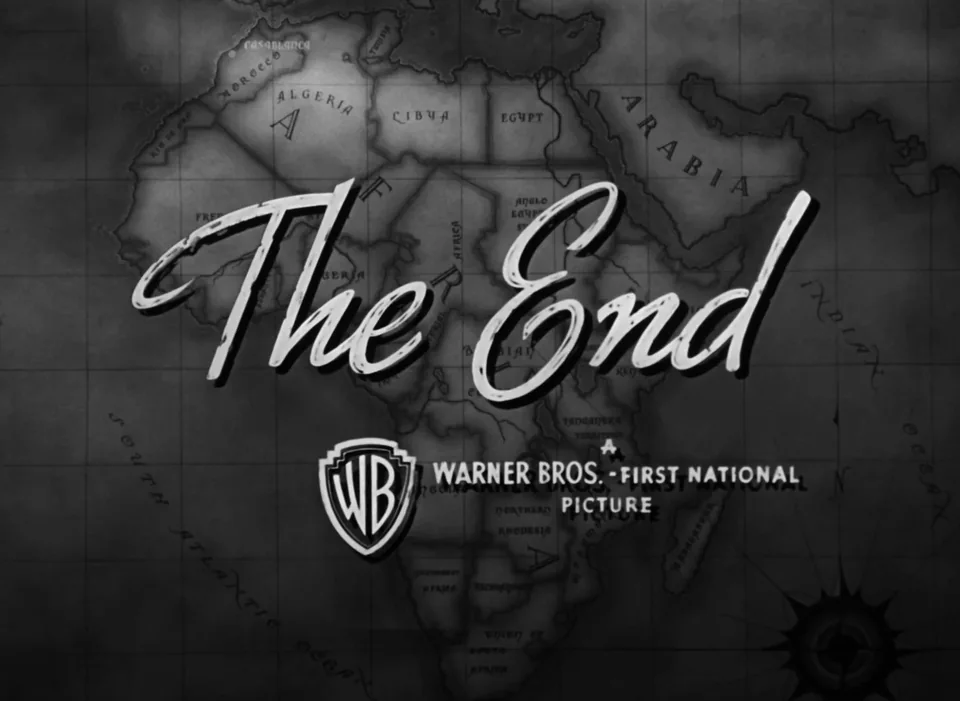
In 1942, Casablanca ends the way almost every Hollywood film of its time ended. Rick and Renault walk off into the fog, the music swells, and a single card fills the screen: The End, with the Warner Bros. shield underneath. It is on screen for about ten seconds. Then the lights come up.
Eighty years later, Top Gun: Maverick ends with eight and a half minutes of names, a river of them. Its stunt team is set three across, in type so small that on a phone it is a texture rather than a list. Near the bottom is a block of legal notices, one of which promises that Paramount did not receive any payment for the tobacco you saw on screen. And the rolls around it credit jobs nobody in 1942 would have recognized: LiDAR Technicians and an Emotional Wellness Coordinator.
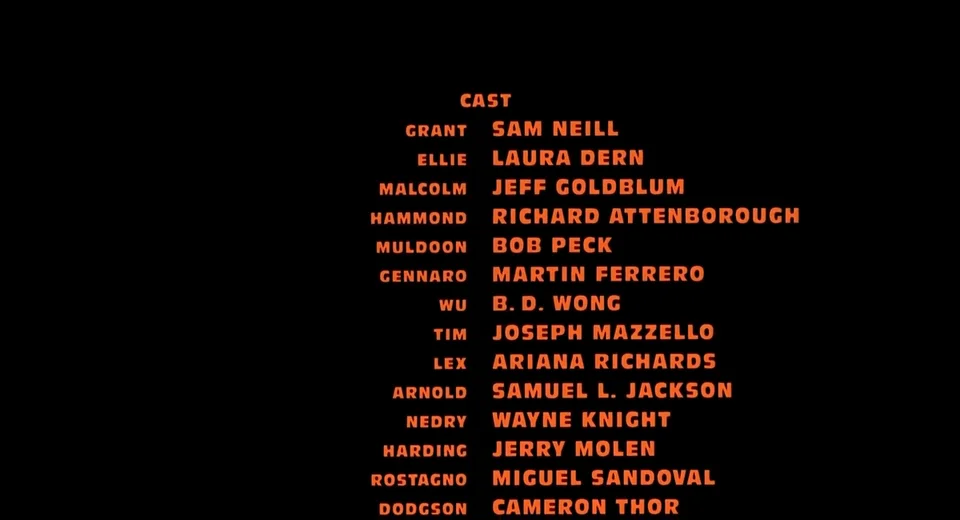
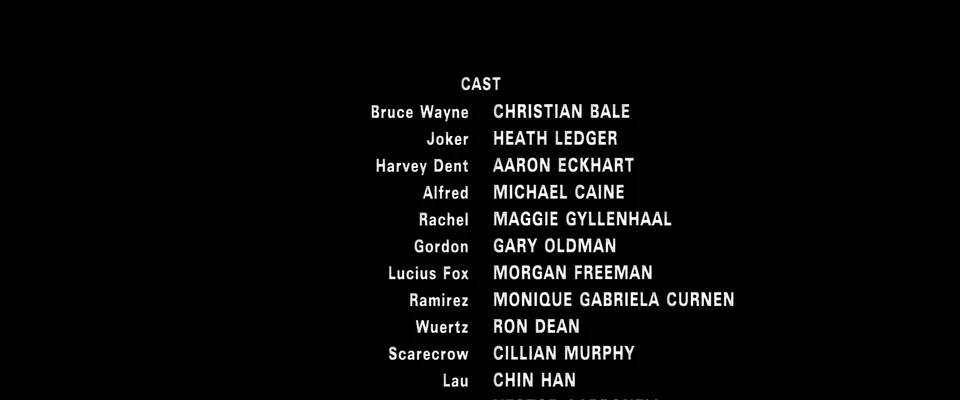
The obvious explanation for the difference is that movies got bigger. More visual effects, more locations, more people. That is true, and it is the least interesting thing about it. Because when you measure end credits, frame by frame, across nearly a century, you find that the length of the roll is only one of the things that changed. Since the 1980s, the type has lost nearly half its height, and lines pass your eye about 70 percent faster. The legal block grew into a wall. And a whole new set of jobs appeared, jobs that did not exist in 1986 and could not have, because the worries they answer did not yet exist.
The end credits, it turns out, are a fossil record.
01The great migration
For the first half of the sound era, credits belonged at the start. The opening titles named the studio, the stars, the director, the writer and the department heads, and that was the end of it. Our films from the 1940s and 1950s end on The End, sometimes with a short cast list, and little more. Psycho (1960) gives you seven seconds.
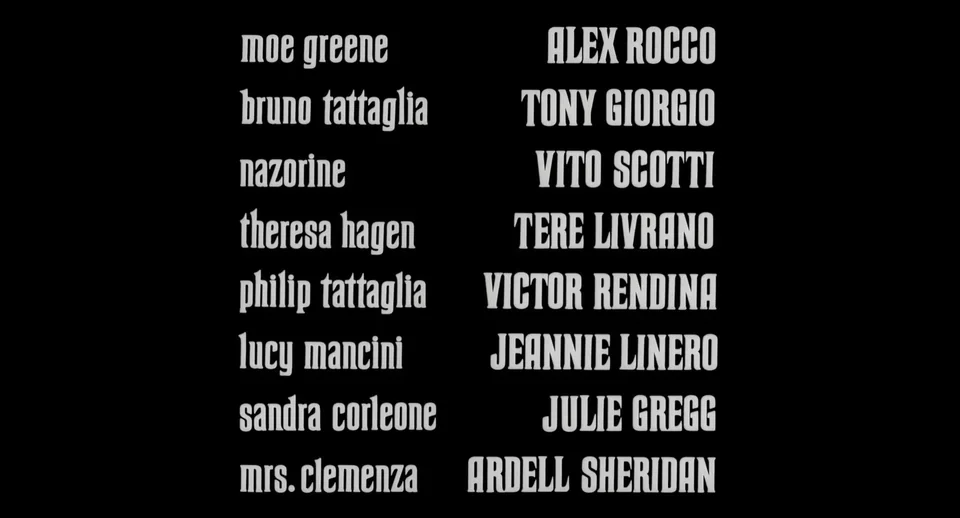
Then a crowd began to gather at the back of the building. Our 1960s films run a median of 38 seconds after the story ends. Our 1970s films run a minute forty. The Godfather (1972) closes on a crawl of two minutes and thirty-seven seconds. By the 1980s, every film we measured runs over two minutes.
Why then? The tempting answer is length: once the list got too long, it could not sit in front of the movie. That is part of it. But length is a symptom.
The early experiments were artistic. Orson Welles opened Citizen Kane (1941) on its title alone and saved the cast for the end.1 Around the World in 80 Days (1956) and West Side Story (1961) gave the end a full credit sequence, and Saul Bass made each one a show of its own.2,3 What made the end crawl permanent was less glamorous: the end of the studio system. In the studio era a gaffer was on MGM's payroll, and most crew went unbilled. After the 1948 Paramount ruling and the rise of television, the studios stopped keeping crews on staff. The gaffer became a freelancer, and a freelancer's credit is a résumé.4
The guilds wrote credit into their contracts: the directors in 1939, the writers in 1941. In 1964 the Directors Guild also fixed where the director's name goes, last in the opening titles.5,6 For those names a credit stopped being a courtesy and became a right. Most crew credits still rest on deal memos and custom.
Here is the strange part. Nobody had left the front. In the late 1970s, almost every one of our top-ten films still named its director in the opening titles. For thirty years, Hollywood ran two sets of credits at once, one for the audience and one for the people on the list.
The guild's rule held. Star Wars (1977) opened with only the studio, the Lucasfilm logo and the title. Lucas had directed it himself, and the guilds let it pass.7 The Empire Strikes Back (1980) did the same, but its director was Irvin Kershner, and his name came only at the end. Kershner had not objected, but the Directors Guild demanded $250,000 in penalties from Lucasfilm and fined Kershner $25,000. Lucas paid it.7,8,9 By the spring of 1981 he had resigned from the Academy and torn up his cards in the Directors Guild and the Writers Guild.8 As late as 1980, a director's name missing from the opening was a scandal.
Then, from the mid-1990s, the front emptied. In the early 1990s, nine of our films in ten opened on their director's name. By the early 2010s, one in seven did.10
02The shrinking letter
Once the credits settled at the end, they began to change shape.
| 1980s | 1990s | 2000s | 2010s | 2020s | |
|---|---|---|---|---|---|
| Length of the end roll | 3.6 min | 5.4 min | 7.2 min | 9.0 min | 9.3 min |
| Lines of credits, about | 180 | 290 | 430 | 630 | 540 |
| Logos in the roll | 6 | 11 | 16 | 22 | 22 |
In forty years the capitals lost nearly half their height. The lines moved more than twice as close together. The crawl itself did not speed up. It moved about an eighth of the screen height a second from the 1980s to the 2000s, and has slowed since. But lines set twice as close mean more of them sweep past: 1.7 lines a second in the 1980s, 3.0 now. Those are the lines a crawl has room for. Headings, gaps and logos use some of them, and more than a quarter of today's roll is not crawl at all.
Then, about a decade ago, the growth stopped. The biggest films have sat at a little over nine minutes since the middle of the 2010s. The exceptions are the ones you would guess: a superhero film now runs over ten. We don't know why the rest stopped. It may be that nine minutes or so is as long as anyone will keep a theater's lights down.
Do the arithmetic. Today's roll runs a little over nine minutes. At the pace of the 1980s, it would run nearly fifteen. The industry traded legibility for completeness, a sliver at a time.
Somewhere along the way the crawl's job changed. The name has to be there. Whether anyone can see it is a separate question.
The more people a film credits, the less any one of them is seen.
03Top Gun, twice
The cleanest way to see the change is to hold one film still and let the decades move around it.
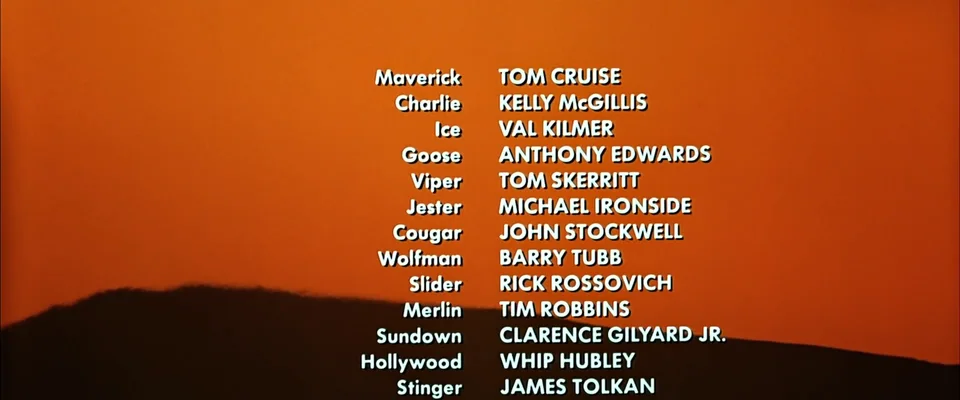
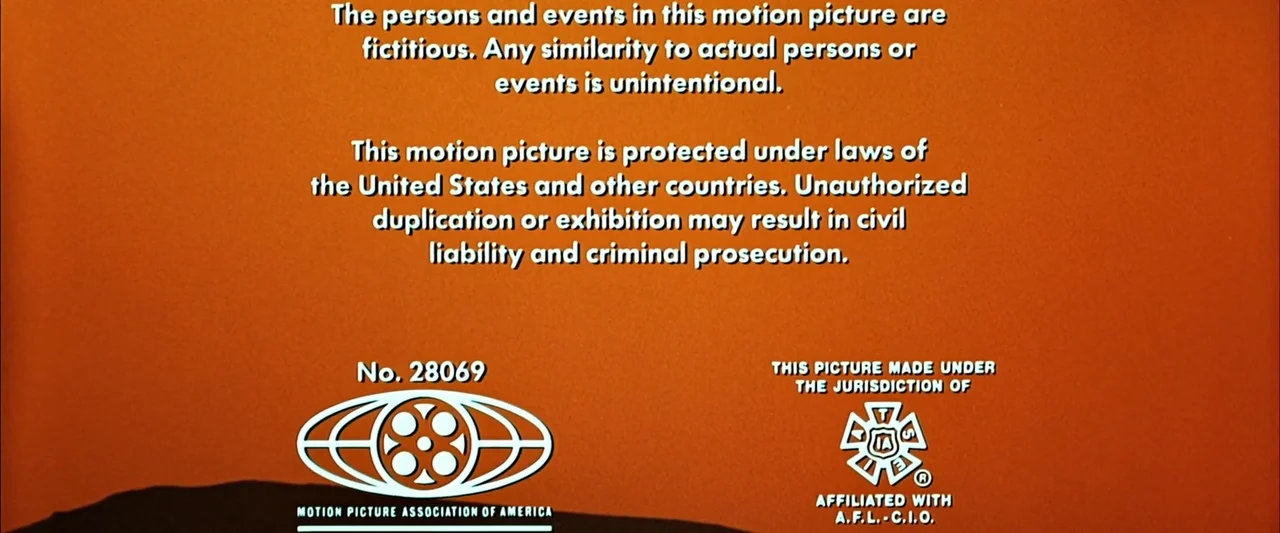
Top Gun (1986) ends over a sunset. The credits roll in a heavy white typeface with a drop shadow, role on the left and name on the right, big enough to read from the back of the theater. The roll lasts five minutes. Its legal block has four parts: the copyright, the statement that the persons and events are fictitious, the anti-piracy warning, and the rating certificate with the union's seal beside it.
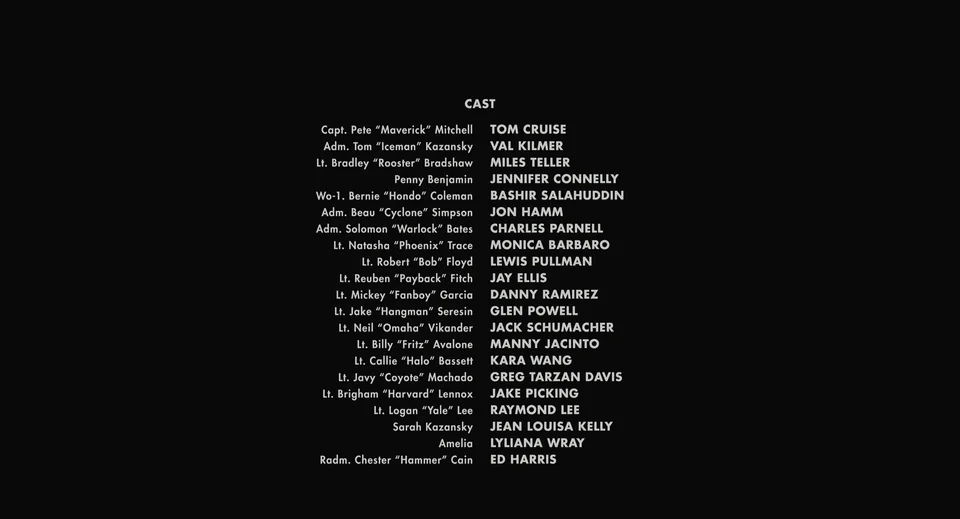
Top Gun: Maverick (2022) ends in black, in smaller white type set in columns and grids. The roll lasts eight and a half minutes and carries about four times as many lines. Its legal block has the same four, and two the 1986 film did not carry: American Humane's word that no animals were harmed, and Paramount's statement that nobody paid for the tobacco on screen. Under them comes a plea: the making of this film supported over 10,000 jobs.
Top Gun · 1986
Top Gun: Maverick · 2022
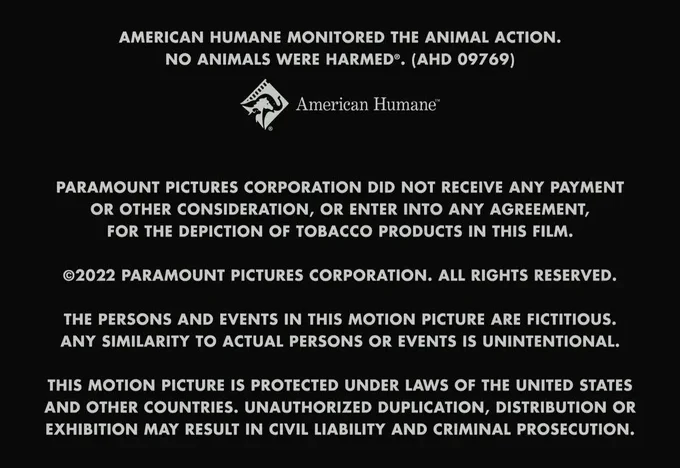
Same studio. Same character. Thirty-six years apart, every new line in the legal block answers a worry the first film never put on screen.
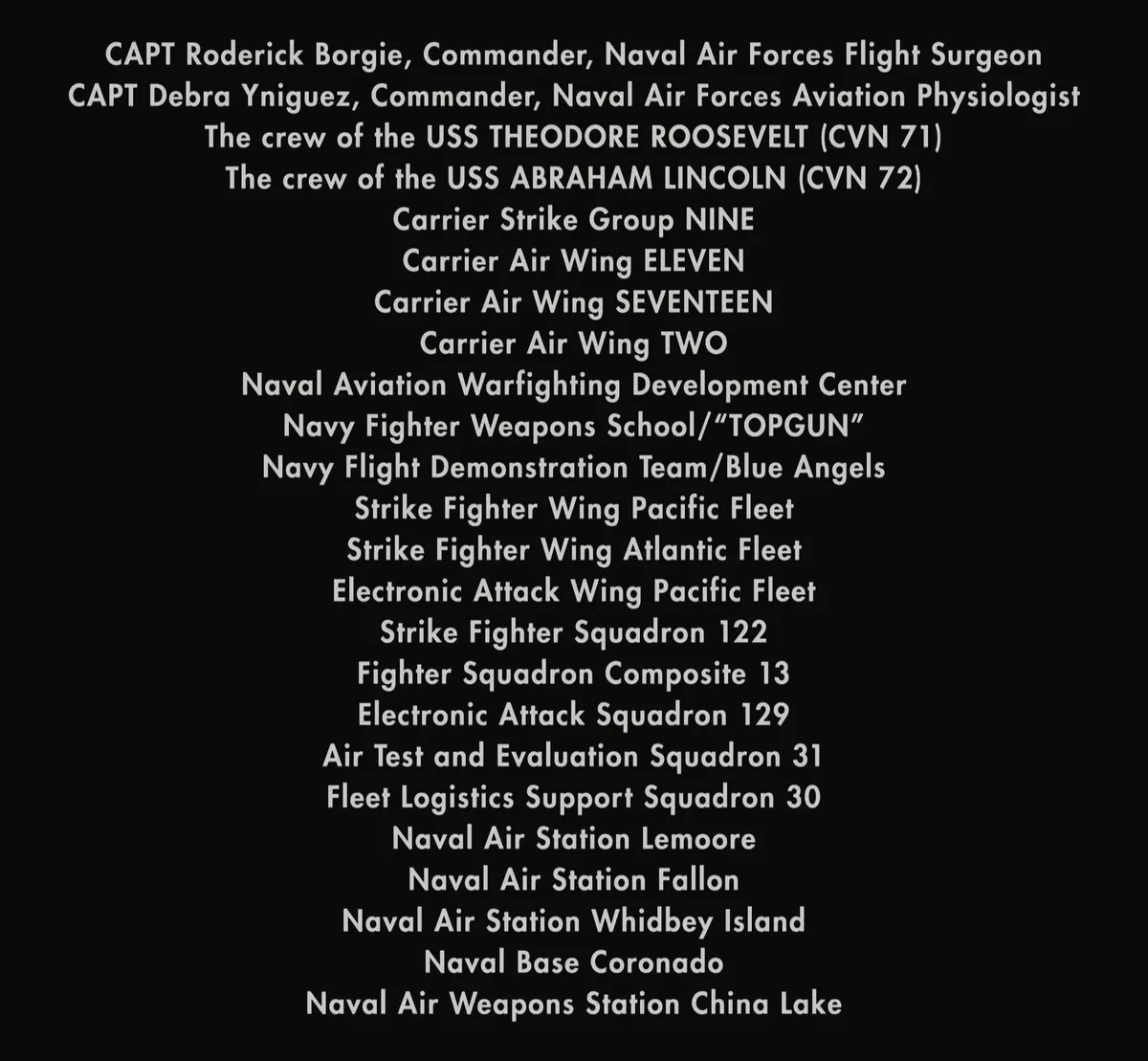
Both films thank the Navy. In 1986 that means the Secretary, four officers and ten commands. In 2022 it means ten officers, two carrier crews and twenty-eight units, one after another, for most of a screen.
Other families tell the same story.
- Alien → Alien: RomulusUnder three minutes and two logos in 1979. Over seven minutes and twenty-six logos in 2024.
- Mad Max → FuriosaTwo and a half minutes of cards in 1979. In 2024, a credit its grandfather could not have imagined: Machine Learning Supervisor.
- Toy Story → Toy Story 5The exception. Four minutes in 1995, over eight by 2010, then back down to just over six. A studio that expects you to watch the credits has a reason to keep them watchable.
04The fossil record
If the size of the type tells you how much the industry cares about being read, the job titles tell you what it was afraid of. This is the share of films in each era that credit a job or carry a notice.
| Before 1990 | 1990–2009 | 2010s | 2020s | |
|---|---|---|---|---|
| Digital imaging technician | 0% | 1% | 42% | 49% |
| Data wrangler | 0% | 2% | 52% | 53% |
| Intimacy coordinator | 0% | 0% | 0% | 5% |
| COVID or health-safety compliance | 0% | 1% | 8% | 20% |
| Sustainability | 0% | 0% | 5% | 14% |
| Lawyers and clearances | 2% | 12% | 18% | 41% |
| "No animals were harmed" | 0% | 37% | 42% | 54% |
| Tobacco notice | 0% | 3% | 32% | 37% |
| Anti-piracy warning | 24% | 78% | 77% | 93% |
| Filmed-in or tax-incentive credit | 13% | 47% | 78% | 90% |
Every row is a story about the world outside the movie.
The digital imaging technician and the data wrangler are the film industry's version of the moment the office got email. When cameras stopped using film, somebody had to manage the files, and that somebody became a department.
The intimacy coordinator appears in none of our films before 2021. Since then it is one in twenty of the biggest hits and one in eight of everything we measured. You can date the moment the industry decided that how actors are treated on a closed set deserved a job title.
The strangest layer in the rock is one pandemic thick. COVID compliance is almost absent from the rolls of 2021. It is on half of everything we measured from 2022 and a fifth from 2024. In 2025 and 2026 it is on nothing at all. A profession arrived, was credited, and left, and the only record of it is a thin band of names.
Sustainability coordinators follow the climate conversation into the roll. Even the tax incentive leaves its mark: nine films in ten now carry a filmed-in or tax-incentive credit for a state or a country, which is to say they carry an invoice.
And the legal block. In 1986 it had four parts. Now it is a liability shield, and it is still growing. Its newest clause arrived in June 2025, when Universal began closing its films with a line that says they "may not be used to train AI." The first, reportedly, was How to Train Your Dragon.11 About one in five of our films from the last two years now carry some version of it.
05The human residue
You might conclude from all of this that end credits have become a machine: contractual, defensive, illegible by design. Mostly, they have. But look closely and people keep sneaking back in.
In 1995, near the end of Toy Story, Pixar credited the crew's dogs, as live action dog reference: April, Jenny, Maggie Mae, Max and Molly. Then it listed its production babies: the children born to the crew while the film was being made. Nobody required it. No contract mentions it. It is on every Pixar roll we measured since; Soul (2020) calls them Recent You Seminar Graduates, after the film's school for souls not yet born, and Lightyear (2022) calls them Future Space Rangers. And it has spread, mostly through animation.
of the extended Fellowship of the Ring's end roll, given to the charter members of the official fan club. Alphabetical, a solid paragraph, thousands of names. Twelve minutes into the list, you have only reached the Ms.
That is the most hopeful thing in the data. In 1942 the end credits were a studio saying the end. By the 1990s they were a workforce saying I was here. Now, at their most generous, they are a whole community saying it: the crew, their children, their dogs, and the fans.
The end crawl is the only part of a film that is about the making of it, which makes it the only part of a film that is about us. It got longer because more of us are involved, smaller because there are more of us than the screen can hold, more defensive because we have learned to fear each other, and, in its best moments, warmer, because we still want to be named.
Nobody reads the end credits. But everybody wants to be in them.
Sources
- AFI Catalog, Citizen Kane: "This film's end credits begin with the statement, 'Most of the principal actors in Citizen Kane are new to motion pictures. The Mercury Theatre is proud to introduce them.'" https://catalog.afi.com/Film/27624-CITIZEN-KANE
- Art of the Title, Around the World in Eighty Days (1956): Saul Bass's animated sequence at the film's close. https://www.artofthetitle.com/title/around-the-world-in-eighty-days/
- Criterion, "Credit Where It's Due: The Father of the Title Sequence": Bass's opening and closing sequences for West Side Story. https://www.criterion.com/current/posts/6937-credit-where-it-s-due-the-father-of-the-title-sequence
- Marketplace, "When did movie credits get so long?" (December 9, 2022), citing David Bordwell, The Way Hollywood Tells It (2006): "Most workers were under contract during the studio era, and thus didn't receive billing"; and Kate Fortmueller (University of Georgia) on credits as the way crew "build on their previous credits and get new work." https://www.marketplace.org/story/2022/12/09/when-did-movie-credits-get-so-long . On the move from studio contracts to package production after 1948: Susan Christopherson and Michael Storper, "The city as studio; the world as back lot," Environment and Planning D 4 (1986), https://doi.org/10.1068/d040305
- Directors Guild of America, history, 1939: the first agreement with the studios "recognizes the Directors' creative function and right to screen credits." https://www.dga.org/the-guild/history/1930s/1939 . Writers Guild of America East, history: the Screen Writers Guild's first contract (1941) "guaranteed writer control of screen credits through the Guild." https://wgaeast.org/?p=14657
- Directors Guild of America, history, 1964: "DGA establishes Bill of Creative Rights, establishing landmarks such as the right to a 'Director's Cut' and to receive final credit on main titles." https://www.dga.org/the-guild/history/1960s/1964 . How the bill was drafted (a committee from November 1963, released April 1964): DGA Quarterly, Spring 2011, https://www.dga.org/Craft/DGAQ/Issues/1101-Spring-2011/Feature-Creative-Rights
- Marcus Hearn, The Cinema of George Lucas (Abrams, 2005), the chapter on The Empire Strikes Back (cited elsewhere as p. 132): "for the first Star Wars, the Writers Guild and Directors Guild had allowed it. But when Lucas did the same for the sequel, they fined him more than $250,000 and even attempted to pull Empire from theaters. The DGA also went after Kershner. To protect his director, Lucas paid all of Kershner's fines to the guild." See also Iain Macdonald, "How the famous Star Wars title sequence survived imperial assaults," The Conversation, https://theconversation.com/how-famous-star-wars-title-sequence-survived-imperial-assaults-52547
- Aljean Harmetz, "But Can Hollywood Live Without George Lucas," The New York Times, July 13, 1981, Section C, p. 11: "His resignation from the Directors Guild came because the guild fined him for placing the director's credit at the end of 'The Empire Strikes Back,' even though Irvin Kershner, the director he had chosen for 'Empire,' did not object"; and, after resigning from the Academy, "he tore up his membership cards in the Writers Guild and Directors Guild this spring." https://www.nytimes.com/1981/07/13/movies/but-can-hollywood-live-without-george-lucas.html .
- J. W. Rinzler, The Making of The Empire Strikes Back (Del Rey, 2010), "Lashing Out," from Lucasfilm's files: on May 28, 1980 the Directors Guild "sent a letter to Lucasfilm asking for a payment of $250,000 in penalties because the director's credit had been placed at the end of the film." The film was made by Lucas's English company under British union rules, so the guild "fined their own member, Kershner, $25,000," and Lucas "paid Kershner's fine." Kershner's contract had put his credit "in first position at the end of the Picture, subject to waiver by the Directors Guild of America," a waiver whose request "seems to have been neglected."
- Deborah Allison, "Beyond Saul Bass: A Century of American Film Title Sequences," Film International (January 30, 2011): "Since 2000, forty percent of the films I've surveyed have opening title sequences of less than thirty seconds in length. This compares with thirteen percent in the late 1990s," and "never more than seven percent in any five-year period before that." https://filmint.nu/beyond-saul-bass-a-century-of-american-film-title-sequences/
- AJ Dellinger, Gizmodo (August 6, 2025): the warning "reportedly first appeared at the end of the live-action How to Train Your Dragon when it hit theaters in June." https://gizmodo.com/universal-adds-no-ai-training-warning-to-movies-2000639747 . William Hughes, The A.V. Club (August 6, 2025). https://www.avclub.com/universal-adds-ai-warning-to-end-credits